
Residential eating disorder treatment in Las Vegas
If you're managing an eating disorder and it doesn't feel like the whole story, with substance use, anxiety or trauma tangled up in it too, you're not alone and you don't have to treat them separately. Our Las Vegas program treats the eating disorder and everything alongside it together, in one plan, with one team.
- Eating disorder and co-occurring substance use treated in one plan, by one team
- A dedicated eating disorder villa at Corbett, with private rooms
- Dietitian-led meal plans, with meals prepared to your plan by a chef
- CBT, DBT, food exposure work and trauma-informed care, matched to you
Check your insurance

Free & confidential • No obligation • Usually answered within minutes





You're not alone
Eating disorders and addiction often go together.

Most people who come to us for eating disorder treatment aren't dealing with just one thing. An eating disorder alongside substance use, trauma, anxiety or depression is common, more common than either being treated on its own would suggest.
Our Las Vegas program is built specifically for that overlap: one team, one clinical plan, treating the eating disorder and whatever else is part of the picture at the same time, not in separate tracks.
That includes mental health. When PTSD, bipolar disorder, borderline personality disorder or severe anxiety is active alongside an eating disorder, you are admitted for the eating disorder and the mental health condition is treated with it, by the same clinicians, in the same villa. Nobody has to decide which problem gets treated first.
Residential care, explained
Inpatient eating disorder treatment and residential care: what the words mean
People looking for help often use inpatient and residential to mean the same thing: living at a treatment center around the clock. At Virtue, eating disorder treatment is residential. You live in a dedicated eating disorder villa on our Corbett campus in northwest Las Vegas, with nurses on site 24 hours a day, a dietitian on the team and every meal prepared to your plan.
Hospital inpatient care is a different step. It is where medical weight restoration and tube feeding happen, and some people need it before residential care is safe. Residential treatment at Virtue is the step after a hospital stay, and a clinical assessment tells us which step should come first for you.
- You live on campus
- Nurses on site 24 hours a day
- A private room, always
- Meals prepared to your plan
Conditions we treat
Eating disorders we treat in our adult residential program
Each of these is treated in the same villa, by the same team, with any co-occurring substance use or mental health care built into the plan rather than referred out. The program is for adults 18 and older.
ARFID →
Texture, sensory and fear-driven restriction, treated with food exposure work. The diagnosis we see most among women in the program.
Anorexia →
Restriction-pattern eating disorders, often alongside anxiety, trauma or substance use, with a dietitian-led meal plan from admission.
Bulimia →
Binge-and-compensate patterns, addressed with CBT-BM and nutrition psychoeducation alongside any co-occurring substance use.
Binge Eating Disorder (BED) →
Recurring loss-of-control eating, treated with CBT-BM and all-foods-fit nutrition support, often alongside substance use or mood conditions.
Co-Occurring Presentations →
Most clients we see are here for more than one thing at once: an eating disorder alongside substance use, trauma, anxiety or depression. That overlap is what this program is built for.
Levels of care
Where residential eating disorder treatment fits
Residential care is one step in a longer path. This is how it connects to what comes before and after, and where our Las Vegas team picks it up. If substance use is part of the picture, detox and the eating disorder villa are on the same campus, with the same clinical team.
- Step 1 Hospital, if needed Medical weight restoration or tube feeding, when the body needs stabilizing first.
- Step 2 Detox villa, if needed When substance use needs medical detox, you start in the detox villa at Corbett.
- Step 3 Eating disorder villa Residential treatment with the same team, so there is no new intake to repeat.
- Step 4 Discharge plan A plan for eating at home, built with your dietitian and therapist before you leave.
Stays are based on clinical need rather than a fixed number of days, and your team reviews progress with you throughout. Before discharge, your dietitian and therapist build the plan for eating at home with you, including outpatient care for substance use when that is part of your recovery.

Residential at Corbett
Eating disorder treatment in Las Vegas, in a villa of its own
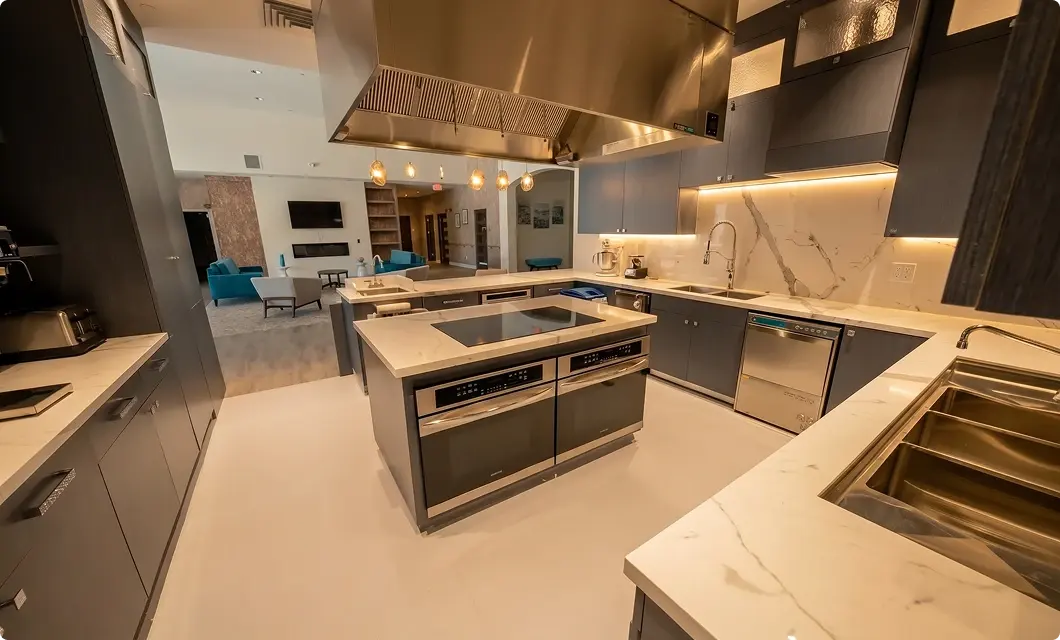
The eating disorder program has its own villa and program space on the Corbett campus. Everyone living there is in eating disorder treatment, so you are not mixed into a general behavioral health census, and every room is private.
Specialty eating disorder techs and a chef prepare every meal to your plan, and a dietitian assesses you before your first meal. Nursing staff are on site around the clock, and the therapeutic garden gives you somewhere to breathe between sessions.
- Private rooms, always
- Dietitian assessment before your first meal
- Meals prepared by a chef to your plan
- On-site therapeutic garden
- 24/7 on-site RN and LPN coverage
- Detox villa transfers directly into the eating disorder villa
For co-occurring substance use: PHP and IOP at Montessouri
When an eating disorder occurs alongside substance use, PHP and IOP at our Montessouri campus treat both together as one co-occurring program. They are not eating-disorder-only outpatient.
View Montessouri →PHP
- 6 hours a day, 5 days a week
- Dietitian within 24 hours of admission
- Weekly nursing assessment and weekly psychiatry
- Nutrition group and meal support
IOP
- 3 to 5 days a week, 3 hours a day
- Weekly dietitian and individual therapist
- Dedicated case manager throughout
- Alumni support at discharge
The differentiator
Few programs treat body image, addiction, and nutrition together. This one does.
If detox comes first, you start in Corbett's detox villa, then transfer into the eating disorder villa with the same clinical team: no new intake, no new story to tell. The eating disorder, any substance use, and the underlying trauma or mood conditions are treated as one clinical picture, not three separate referrals.

What treatment looks like
Evidence-based, dietitian-led, at every level of care.
Therapy and nutrition work happen side by side in the villa. The aim is to heal your relationship with food and with yourself, using an intuitive eating approach and a lot of hands-on food exposure work, so that by discharge you can listen to your body and nourish yourself at home.
CBT-ED / CBT-BM
Enhanced CBT adapted for restriction and binge-eating patterns, the gold-standard psychological intervention for eating disorders.
DBT
Targets the emotional dysregulation and distress-tolerance deficits that often underlie disordered eating.
Motivational Interviewing
For the part of you that is unsure about change, so ambivalence becomes something to work with.
Trauma-Informed Care
Therapy that accounts for the trauma that often sits underneath an eating disorder.
Mindfulness
Present-moment practices that build tolerance for the anxiety eating and body image can trigger.
Meal Support
Staff-supported meals: structured, non-punitive eating while you build a different relationship with food.
Read more →Food Exposure Work
Preparing foods together and trying new textures, at a clinically appropriate pace.
Intuitive Eating Approach
Relearning to notice hunger and fullness, so eating is guided by your body rather than by fear.
Nutrition Psychoeducation
Dietitian-led education on how the body and brain interact with food, separating fear from physiology.
Read more →Family Therapy
Family therapy at Corbett residential. Family contact is clinical, not incidental.
Medication Management
Psychiatric and medical evaluation on admission, with medication management throughout.
Co-Occurring Mental Health
PTSD, bipolar disorder, anxiety and other conditions treated alongside the eating disorder.
If you're calling for someone else
For families, and for parents of teenagers.
This program treats adults 18 and older. If you're a parent or caregiver worried about a teenager, call us anyway. We'll talk through what you're seeing and help point you toward care that's appropriate for their age.
For adult clients, family is part of recovery here, not an afterthought: family therapy at Corbett, a weekly virtual family support group at Montessouri, and alumni support once treatment ends.


For veterans
Eating disorder treatment for veterans, through VA Community Care
Virtue is one of the few residential programs that accepts VA Community Care referrals for eating disorders. Your VA care team can refer you to the Corbett villa, and stays the VA authorizes can be extended when you need more time.
For many veterans, restriction started with military weigh-ins and body standards, and military sexual trauma or PTSD often sits underneath it. Our trauma-informed team treats those together with the eating disorder, in the same plan.
Treatment for veterans →Common questions
Questions about residential eating disorder treatment
Anything not answered here, ask on the call. There is no obligation.
(866) 461-3339- Do you treat eating disorders and addiction together?
- Yes. This is the core of the Las Vegas program. Most clients we see are managing an eating disorder alongside substance use, and the two are treated together by one team, not as separate programs you have to move between.
- What eating disorders do you treat?
- ARFID, anorexia, bulimia and binge eating disorder, especially when they co-occur with substance use, trauma, anxiety or depression. If you're unsure whether your presentation fits, call admissions and they'll be direct about what the program is built for.
- Is residential the same as inpatient eating disorder treatment?
- People often use the two words to mean the same thing: living at a treatment center around the clock. At Virtue, eating disorder treatment is residential, in a dedicated villa on our Corbett campus with nurses on site 24 hours a day. Hospital inpatient care, where medical weight restoration or tube feeding happens, comes first for people who need it, and residential here is the next step.
- What levels of care do you offer for eating disorders?
- Primary eating disorder treatment is residential, in a dedicated villa at Corbett, with detox first if needed. Length of stay is based on clinical need. If your eating disorder occurs alongside substance use, we also offer PHP and IOP at Montessouri that treat both together as one co-occurring program. We don't offer eating-disorder-only outpatient, but our team will help you find the right fit either way.
- Will I be forced to eat?
- No. The goal of meal support is to remove the alone-ness of eating while you work through it, not to force you. Meals happen with staff present who understand the anxiety eating can trigger. You won't be left alone with it, and you won't be punished for struggling.
- What if I also struggle with substance use?
- That's exactly who this program is for. If you need medical detox first, you'll start in the detox villa at Corbett, then transfer to the eating disorder villa with the same team, so you don't start over with new people.
- Do you treat eating disorders in teens or adolescents?
- This program is for adults 18 and older. If you're a parent or caregiver looking for help for a teenager, call us anyway. We'll talk through what you're seeing and help point you toward age-appropriate care.
- Is the program private? Will other patients know why I'm there?
- The Corbett eating disorder villa is a dedicated population: everyone there is in treatment for an eating disorder, so you're not mixed into a general behavioral health census. Confidentiality is federal law under HIPAA, and staff at both campuses work exclusively with this population.
- Can family be involved?
- Yes, and for most clients it's part of recovery. Family therapy is part of the clinical model at Corbett; Montessouri has a weekly virtual family support group plus alumni support at discharge. If you're ambivalent about involving family, that's something to raise with your therapist. It won't be forced.
- Is this program available at other Virtue locations?
- The dedicated eating disorder program runs in Las Vegas: residential eating disorder care at Corbett, plus PHP and IOP at Montessouri for eating disorders that co-occur with substance use. Other Virtue locations treat substance use and co-occurring mental health, but the dedicated eating disorder clinical model and dietitian team are Las Vegas-specific. If you're not in Las Vegas, call us anyway. We can talk through options.
- Does insurance cover eating disorder treatment?
- Many commercial plans with mental health benefits cover residential eating disorder treatment, and Virtue accepts out-of-network plans. Veterans can be referred through VA Community Care. Eating disorder insurance coverage varies by plan, so our admissions team verifies your specific benefits for free before you commit to anything.
You are allowed to ask
If you are calling for someone else
Most people who call us are calling about someone they love. You can ask about the options and check their insurance on their behalf, and it stays a conversation until you decide otherwise.
Related reading
Anorexia treatment
Residential anorexia treatment that treats the anxiety, trauma or substance use underneath it.
Read the guide →Eating disorders and addiction
Why the two so often arrive together, and how one team treats both.
Read the guide →Nutritional counseling
How our dietitians build and adjust meal plans during treatment.
Read the guide →Insurance
We accept most major insurance plans.
For eating disorder care, Virtue works with commercial plans that include mental health benefits, including out-of-network plans, and with VA Community Care for veterans.








And most PPO plans. Coverage varies by plan and by facility, so if your carrier is not shown, ask rather than assume.
- Free, and there is no obligation at the end of it
- Usually answered within minutes during the day
- You can check on behalf of someone else
- Admissions answers the phone 24 hours a day
- No insurance? Ask about private pay options. Nobody is turned away without knowing their next step.
Check my insurance coverage
100% confidential · No commitment required
Still have questions? Call us.
Admissions will verify your insurance and arrange a free clinical assessment, which is what determines your level of care.
Confidential. No obligation. Someone answers, 24 hours a day.
