






















Every year, people die from fentanyl without knowing they took it. The drug has no taste, smell, or color that sets it apart. It is now found in cocaine, MDMA, counterfeit pills, and other substances across the United States.
Understanding how this happens, and what you can do about it, is information that can save a life.
What Is Fentanyl and Why Is It So Dangerous?
Fentanyl is a synthetic opioid originally developed for severe cancer pain. It is estimated to be 50 to 100 times more potent than morphine, which means a potentially lethal dose is smaller than a few grains of salt. In a medical setting, dosing is precisely controlled. In the illicit drug supply, it is not [2].
Illicitly manufactured fentanyl is produced in unregulated facilities and mixed into other substances in concentrations that are invisible to the naked eye. Someone with no opioid tolerance who unknowingly encounters a fentanyl-laced drug has almost no margin for error.
In 2024, 47,735 overdose deaths in the United States involved synthetic opioids other than methadone, the category that includes illicitly manufactured fentanyl. That figure reflects a 35.6% decline from 2023, which is real progress. It is not, however, the end of the crisis [1].
How Common Is Fentanyl in Today’s Drug Supply?
More common than most people realize. In 2023, U.S. law enforcement seized over 115 million counterfeit pills containing illicit fentanyl [3]. Those pills are pressed to look exactly like prescription oxycodone, Xanax, Adderall, and other common medications, and they are often indistinguishable from the real thing without lab testing.
Fentanyl is also showing up in stimulants. A 2023 analysis of 718 lab-confirmed drug samples from harm reduction programs across 25 states found fentanyl in approximately 12.5% of powder methamphetamine samples and 14.8% of powder cocaine samples. In most of those cases, the person who submitted the sample did not know or expect fentanyl to be present [4].
Which Drugs Are Being Laced with Fentanyl?
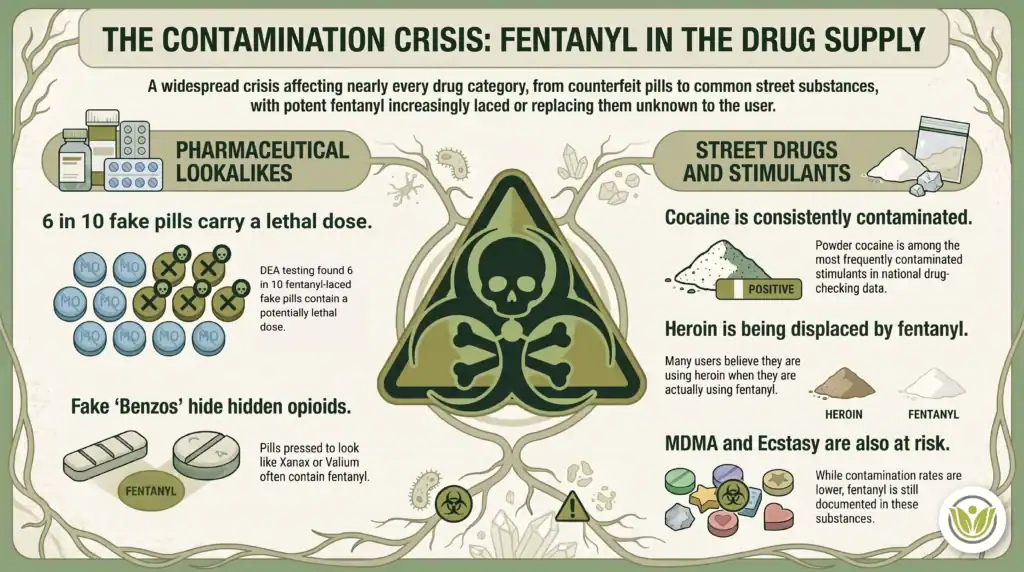
No drug category is entirely immune. Research and seizure data consistently point to the same substances appearing most often [2]:
Counterfeit opioid pills pressed to look like oxycodone (M30S) or hydrocodone. DEA testing has found that roughly 6 in 10 counterfeit M30 pills contain a potentially lethal dose of fentanyl.
Fake benzodiazepine pills pressed to look like Xanax or Valium, often consumed by people with no idea they were taking an opioid.
Powder cocaine, one of the most consistently contaminated stimulants in drug checking data from community programs across the country.
MDMA and pressed ecstasy tablets, where contamination rates are lower but documented.
Heroin, which in much of the U.S. has been largely displaced by fentanyl or heavily mixed with it, meaning many people who believe they are using heroin are using fentanyl or a combination of both.
Why Is It So Hard to Recognize a Drug Laced with Fentanyl?
Fentanyl is odorless, colorless, and tasteless. It blends into other substances without changing their appearance, texture, or smell in any way that a person can reliably detect. A drug sample can look, smell, and feel exactly like one that contains no fentanyl.
Because fentanyl is so potent, a lethal dose can be invisible to the eye. Mixing it into a powder or pill also produces what researchers call the hotspot effect: uneven distribution within a batch means some portions can carry far higher concentrations than others. Two pills from the same bag can produce completely different outcomes.
There is no reliable way to detect fentanyl by sight, smell, or taste. The only method that works is testing with a tool designed for it.
Do Fentanyl Test Strips Actually Work?
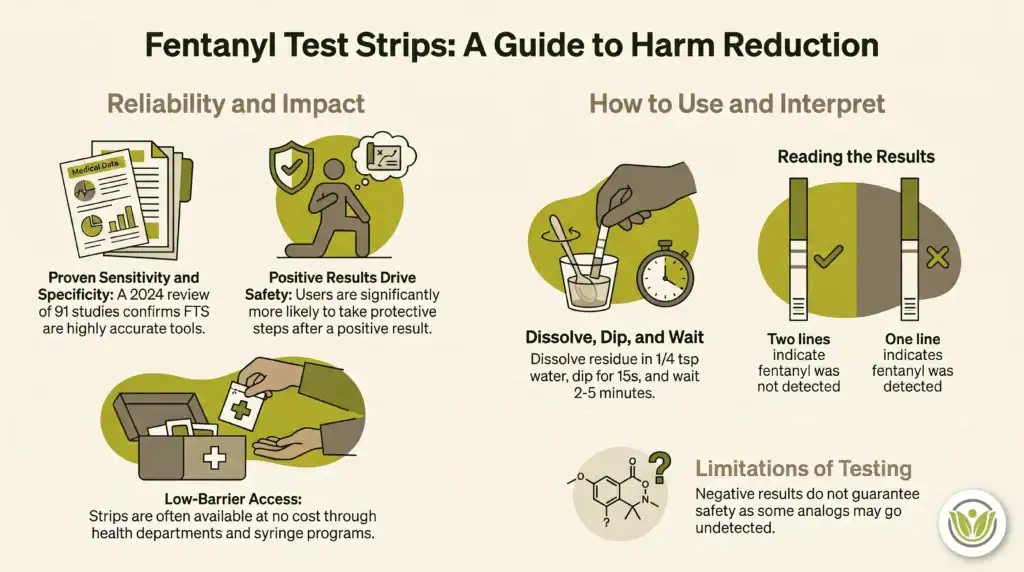
Yes. Fentanyl test strips (FTS) detect fentanyl in a dissolved drug sample before it is used. A 2024 scoping review of 91 studies found strong evidence supporting the sensitivity and specificity of test strips as a public health tool. People who receive a positive result are significantly more likely to take protective steps before using [5].
How to use a fentanyl test strip on a drug sample:
Dissolve a small residue of the substance in water (about ¼ teaspoon).
Dip the strip into the solution for 15 seconds, then lay it flat on a clean surface.
Wait 2 to 5 minutes to read the result. Two lines mean fentanyl was not detected. One line means fentanyl was detected.
A negative result does not mean the drug is entirely safe. Test strips detect fentanyl but may not detect every fentanyl analog.
Fentanyl test strips are legal in most states and available through harm reduction programs, syringe service programs, and many health departments, often at no cost.
What Are the Signs of a Fentanyl Overdose?
Fentanyl overdoses come on faster than other opioid overdoses and are harder to reverse without naloxone. Signs include slow, shallow, or stopped breathing; blue or grayish lips or fingertips; unresponsiveness; pinpoint pupils; and gurgling or choking sounds.
If someone becomes suddenly unresponsive:
Call 911 immediately.
Administer naloxone (Narcan) if available. Fentanyl often requires more than one dose. If there is no response after 2 to 3 minutes, give a second dose.
Stay with the person until help arrives.
Most states have Good Samaritan laws that protect people who call 911 during an overdose from drug-related prosecution.
Naloxone is available without a prescription at most pharmacies and through many harm reduction programs at no cost.
If This Is Hitting Close to Home, Find A Virtue Recovery Center Near You
Awareness is a starting point, not a finish line. If you or someone you care about is using substances in an environment where fentanyl contamination is a real risk, that conversation is worth having without shame or judgment.
Virtue Recovery has fentanyl addiction treatment programs across multiple states, including Texas, Arizona, Nevada, and Oregon, for people at all stages of the recovery process, whether you are still asking questions or ready to make a change now. Our team understands the realities of today’s drug supply and meets people where they are. Reach out whenever you are ready.
Sources
| [1] | Garnett, M. F., & Miniño, A. M. (2026). Drug overdose deaths in the United States, 2023–2024. NCHS Data Brief (549). Centers for Disease Control and Prevention. |
| [2] | National Institute on Drug Abuse. (n.d.). Fentanyl. National Institute on Drug Abuse. |
| [3] | National Institute on Drug Abuse. (2024, May). Over 115 million pills containing illicit fentanyl seized by law enforcement in 2023. National Institute on Drug Abuse. |
| [4] | Wagner, K. D., et al. (2023). Prevalence of fentanyl in methamphetamine and cocaine samples collected by community-based drug checking services. Drug and Alcohol Dependence, 252, 110985. |
| [5] | Kutscher, E., et al. (2024). Fentanyl test strips for harm reduction: A scoping review. Journal of Addiction Medicine, 18(4), 373–380. |